
Fire safety in the workplace deserves your full attention, and not just because the law says so. The Occupational Health and Safety (OHS) Act 85 of 1993 places a clear legal duty on every employer to provide, as far as is reasonably practicable, a working environment that is safe and without risk to the health and safety of employees or anyone else affected by your work. Fire is one of the most serious hazards any workplace can face, and the OHS Act requires employers to manage fire risks.
Fire risk assessments and policies
A solid fire prevention and fire safety programme starts with a fire risk assessment that helps you identify fire risks specific to your premises and operations. Some of the most common fire hazards in South African workplaces include electrical overloads or poor wiring, faulty or damaged electronic equipment, flammable substances, the build-up of combustible waste, and poor housekeeping.
Employers are required to have a written Health and Safety Policy that covers both fire prevention measures and emergency protocols. This is not just a document for the filing cabinet. It needs to reflect how your business actually operates and must be clearly displayed in the workplace.
Your building also needs to comply with SANS 10400-T, which is the South African National Standard for fire protection in buildings. This covers everything from compartmentalisation to fire door specifications. If you have recently moved premises or done internal renovations, it is worth confirming that your current layout still meets the standard.
Means of escape and evacuation

When a fire breaks out, people need to be able to get out quickly and safely. That sounds obvious, but the details matter enormously.
-
All staircases, fire escapes, and emergency exit routes must be completely clear of obstructions at all times. A blocked fire escape is a compliance failure and a potential tragedy.
-
Emergency escape doors must, as far as is practicable, open outward and be capable of being opened easily and rapidly from the inside.
-
Provide emergency lighting that keeps escape routes visible during a power failure.
One detail that many employers get wrong is the assembly point setup. Businesses should plan for two designated assembly points: Assembly Point A as your primary gathering point location, while Assembly Point B is positioned further away from the building. The reason for the second point is practical. If a fire escalates and the primary assembly area becomes unsafe or too close to the incident, you need a pre-designated alternative that the health and safety team already knows about.
Once everyone has reached the assembly point, a roll-call must be conducted to confirm that all staff and visitors are accounted for. This step is non-negotiable and needs to be practised during evacuation drills.
Firefighting equipment and maintenance
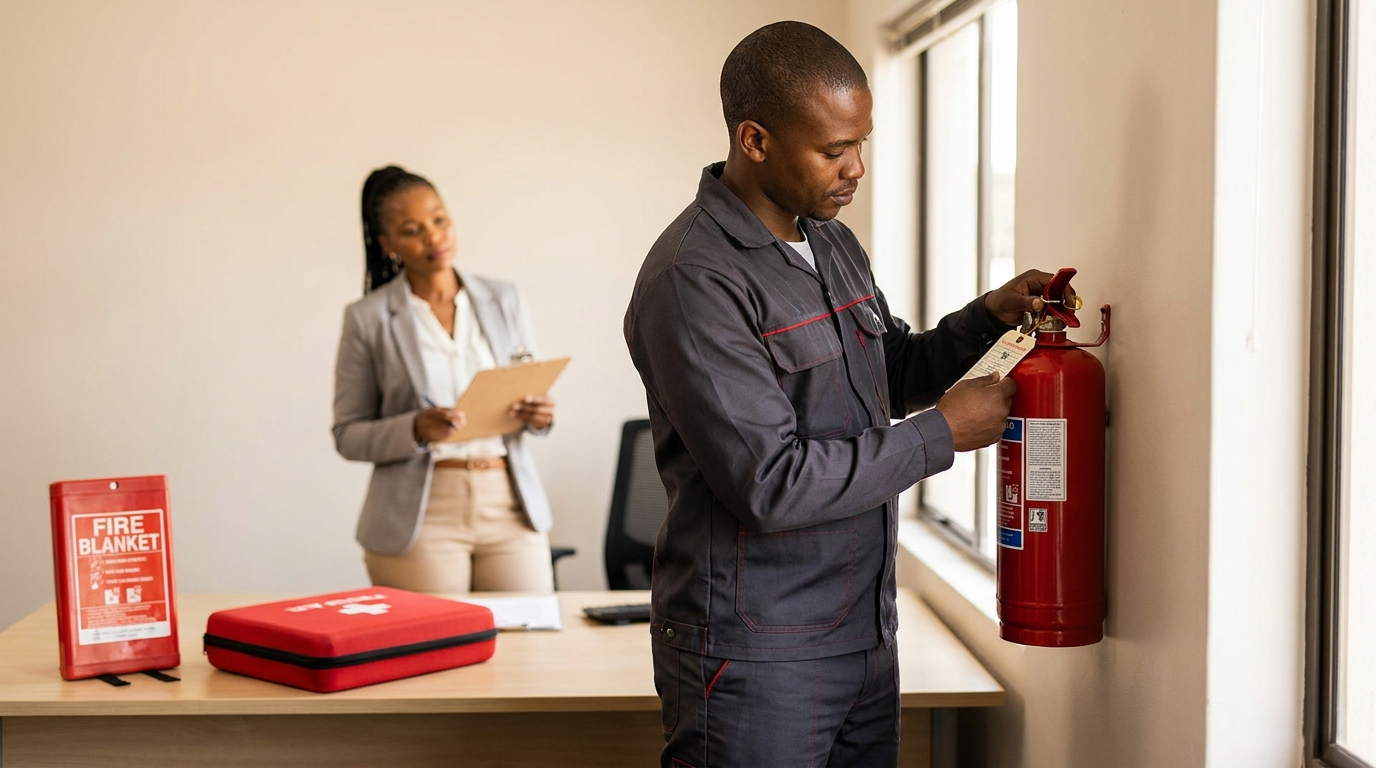
The right equipment, properly maintained, gives your staff the means to quickly extinguish a small fire before it grows. The wrong equipment, or equipment that has not been serviced, can make things worse or fail entirely when it matters most.
-
For low-risk offices, one portable fire extinguisher per 200 square metres is a general rule of thumb. The number and type required depend on the building’s occupancy, size, layout, activities, and applicable local requirements.
-
The type of extinguisher must match the fire class in each area. CO2 extinguishers are suited to electrical fires. Water or foam extinguishers work for Class A materials like wood and paper. Never use water on electrical fires or flammable liquid fires.
-
All extinguishers must be serviced and their service labels updated annually by a SAQCC-registered fire equipment servicing technician, in line with SANS 1475.
-
Smoke alarms, fire panels, and sprinkler systems all require regular testing and maintenance.
Our other articles provide further guidance on choosing the right fire extinguisher for your specific environment or reviewing your broader firefighting equipment.
Employee training and drills
Every workplace should have designated Fire Wardens and Evacuation Marshals. These are two distinct roles with different responsibilities:
-
Fire Wardens are trained to extinguish fires using the appropriate equipment and to support ongoing fire prevention programmes within the workplace.
-
Evacuation Marshals are trained specifically to guide people safely out of the building during an evacuation, manage the movement of staff to assembly points, and assist anyone who needs help.
Fire drills should happen at least twice a year. They should be taken seriously, timed, and debriefed so that gaps can be identified and addressed. Drill reports should be completed and kept on file as they are important compliance documents recording the drill, findings, and corrective actions.
All staff should understand the PASS method for using a fire extinguisher: Pull the pin, Aim at the base of the fire, Squeeze the handle, and Sweep from side to side. Only trained people should attempt to extinguish a fire, and only when it is safe to do so and they have a clear escape route. However, knowing the PASS acronym isn’t enough; Fire Wardens need to have a clear understanding of different fire classes, types of extinguishers, and how to assist with fire risk assessments. This is why accredited Fire Warden and firefighting training is needed. A one-day, hands-on course can make the difference between an appropriate response and a complete disaster.
Managing flammable substances
If your workplace uses or stores flammable liquids or gases, the way those substances are managed is a significant part of your fire safety in the workplace obligations.
-
Flammable substances should be stored in designated areas away from ignition sources.
-
Hot work activities including welding, soldering, and cutting require appropriate safety precautions, adequate ventilation, suitable PPE and safety equipment, and clearly implemented and enforced safety procedures.
For a broader look at practical fire prevention tactics your business can implement, that resource covers the operational side of keeping ignition risks under control.
The cost of getting it wrong
Non-compliance with fire safety regulations in South Africa is not a minor administrative issue. The Department of Employment and Labour can issue prohibition notices and stop unsafe processes where serious risks are identified. In serious cases, investigations into non-compliance or negligence can lead to criminal prosecution of the business or responsible individuals, including managers or the CEO. In addition, insurers may dispute or decline claims where non-compliance contributed to the incident.
If you are not confident that your current fire safety measures meet the requirements of the OHS Act and applicable fire safety regulations in South Africa, now is the time to address it. Review your fire risk assessment, check your equipment servicing records, walk your evacuation routes, and check the validity of your Fire Wardens’ training certificates.
First Aid, Fire and Safety Training offers accredited fire safety courses designed to give your team the knowledge and practical skills they need. Getting your people properly trained is one of the most valuable investments you can make in keeping your workplace safe and your business compliant. Reach out to our team and let us help you get it right.