
Every year, people suffer sudden cardiac arrests at work. A colleague collapses in a warehouse, a client loses consciousness in a reception area, a co-worker goes down on a construction site. In those first few minutes, the presence of someone trained in CPR can mean the difference between life and death.
CPR, or cardiopulmonary resuscitation, is the combination of chest compressions and rescue breathing used to maintain blood flow to the brain and vital organs when the heart stops beating by itself. This core first aid skill can help keep someone alive after cardiac arrest while waiting for paramedics to arrive.
What South African law says about CPR in the workplace
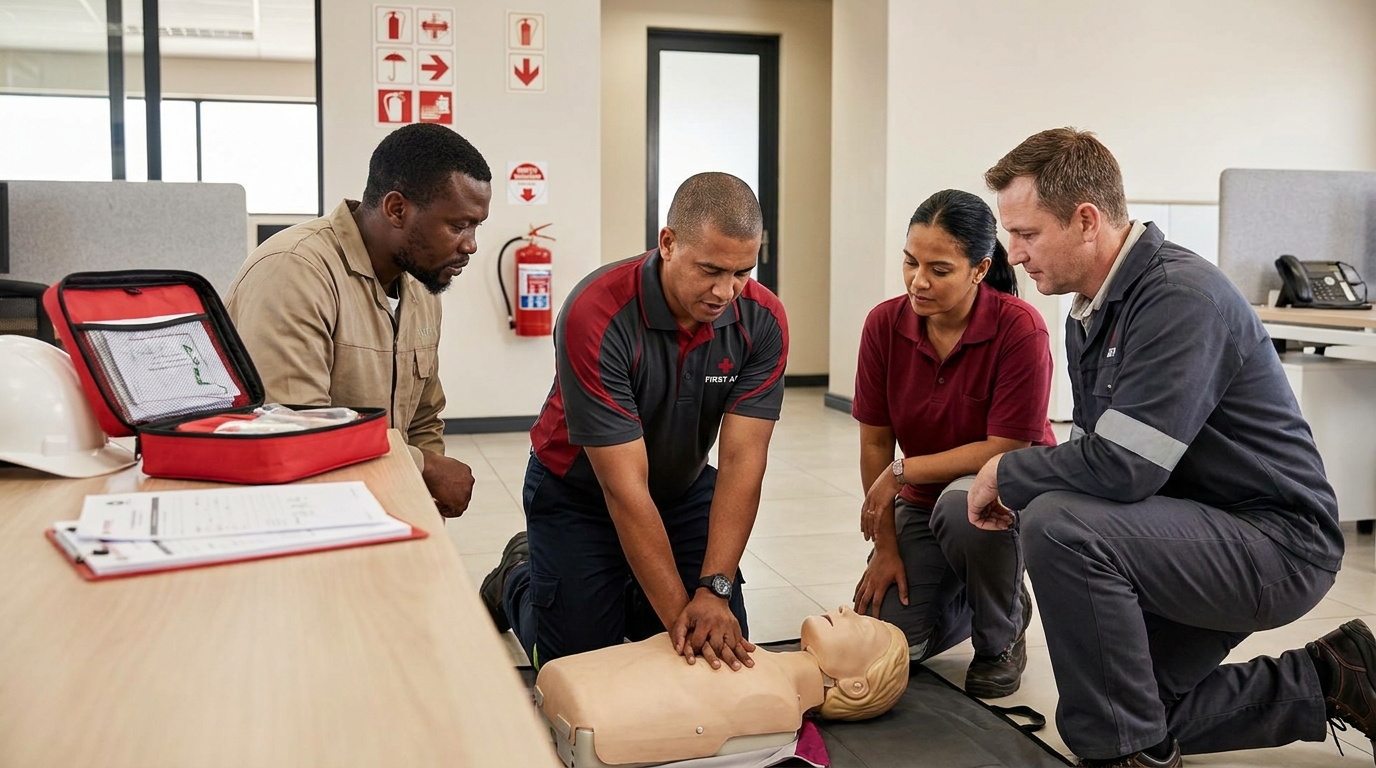
The Occupational Health and Safety (OHS) Act places a clear duty on every employer to ensure that prompt first aid treatment is available to employees. Specifically, the Department of Employment and Labour (DoEL) requires that a person holding a valid first aid certificate be on-site during normal working hours. Any business employing 11 or more people must legally appoint at least one certified First Aider.
CPR is a core component of all accredited first aid training in South Africa. You cannot hold a compliant first aid certificate without demonstrating competency in cardiopulmonary resuscitation. The legal requirement for CPR training in South Africa is therefore built into the requirement for first aid training, even if the Act does not spell it out in those terms. All training must be issued by a DoEL-approved and HWSETA/QCTO-accredited training provider to count toward compliance, and a full picture of exactly what the regulations require is set out in First Aid Training Requirements: Complying with the Department of Employment and Labour’s Regulations.
How many First Aiders do you need
The staff ratios prescribed under the OHS Act regulations are straightforward. In general workplaces, you need at least one First Aider for every 50 employees. In shops and offices, the requirement is one First Aider per 100 employees. High-risk industries such as manufacturing and construction may require more First Aiders, or a higher level of training, based on a formal risk assessment.
Certificate validity and what happens when certificates lapse

Illustration: Certificate validity and what happens when certificates lapse
First aid and CPR certificates are valid for a specific time period, which is detailed on the certificate (usually three years). When that period expires, the holder is no longer a recognised First Aider for compliance purposes.
When a certificate reaches the end of its validity, employees need to redo the course or preferably complete a higher level of first aid certification. Build renewal dates into your HR calendar and budget for them so that the gap never opens up.
CPR training must be hands-on
First aid and CPR training must be delivered in person and be practical in nature. You cannot certify through an online-only course because CPR requires physical practice: Performing chest compressions on a manikin, managing an airway, using a bag-valve mask, and working through real emergency scenarios with an instructor present.
Online-only CPR certificates are not legally recognised for OHS Act compliance.
A note on levels of training
First aid training in South Africa runs from Level 1 (or Basic) upward, and CPR is included at every level. For most workplaces, the Basic First Aid (Level 1) certificate is the correct course. It meets the OHS Act requirements, covers CPR alongside other essential first aid skills, and results in a recognised certificate. Higher-risk environments may warrant Level 2 or Level 3 training. If you are unsure which level is best for your workplace, a quick conversation with an accredited provider will point you in the right direction.
*For those in professional healthcare roles looking for CPR and BLS training, CPR for Professionals and BLS for Healthcare Providers are the correct courses to look at.
Where to start
If you are reading this as an HR manager trying to work out whether your workplace is covered, the two questions worth asking right now are these: Do you have the correct number of First Aiders appointed based on your company size, and are all your First Aiders’ certificates still within their three-year validity window?
If the answer to either question is no, or if you are not entirely sure, feel free to get in touch directly. We are happy to help you work out exactly what your workplace needs and find a training date that fits your team’s schedule. Alternatively, have a look at our available First Aid courses here.