
CPR is one of the most critical skills in first aid. When someone suffers a cardiac arrest, their heart stops pumping blood effectively to the brain and vital organs. Every second counts: Brain cells can begin to die within minutes without oxygen, and without immediate intervention, the risk of permanent brain damage or death rises sharply. CPR helps maintain blood flow and oxygen delivery while an AED and professional medical help are obtained, buying precious time that can improve the casualty’s chances of survival.
Why CPR matters
Cardiac arrest can happen anywhere: At a sports field, in an office, at a school, or at home. When it does, the people closest to the casualty may be bystanders, colleagues, family members, or coaches. Their actions in the first few minutes can make a significant difference.
Survival chances decline rapidly when CPR and defibrillation are delayed. CPR helps keep oxygenated blood circulating to the brain and other vital organs while help is on the way. This circulation helps reduce the risk of brain damage and preserves the casualty’s chances of survival until professional help arrives.
Who should learn CPR
CPR training is sometimes thought of as a requirement for certain jobs; a box to tick for First Aiders, healthcare workers, or emergency responders. But CPR is a life skill, and anyone who wants to be better prepared to help in an emergency has good reason to learn it.
Parents and caregivers are an obvious group. Teachers and coaches work with children every day in environments where medical emergencies can occur. Office workers are likely to be the first people on the scene when a colleague collapses. Gym staff, security personnel, retail workers, and hospitality staff regularly interact with members of the public. In all of these settings, a trained bystander can make a difference.
Beyond specific roles, the argument for CPR as a general life skill is straightforward. The person who needs help could be a family member at the dinner table or a stranger in a public space. Training helps you understand what to do and builds confidence to act.
What to expect from a CPR course
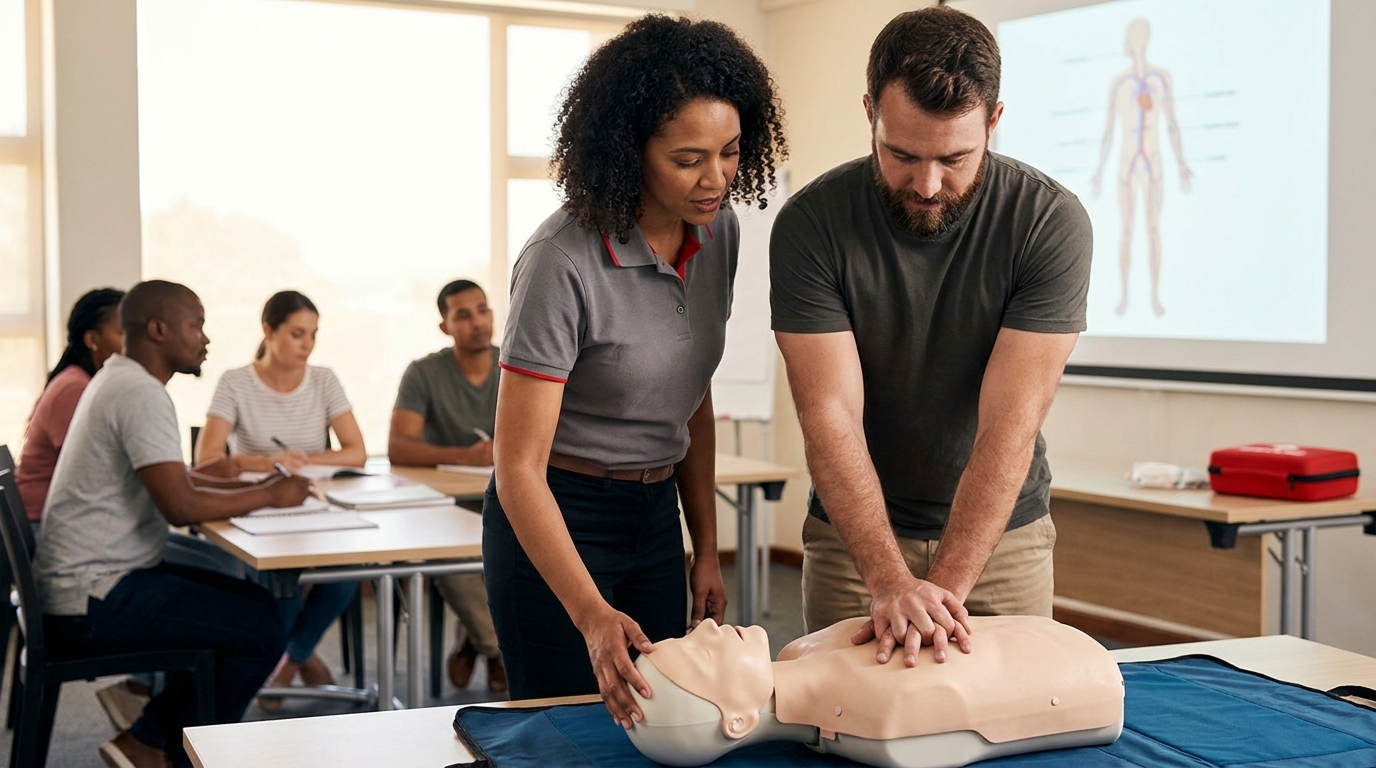
A well-structured CPR course combines theoretical knowledge with practical training. The exact content depends on the course and its intended audience, but the aim is to help delegates understand and practise the skills needed to respond effectively.
The theory component
Delegates learn the purpose of CPR and how it helps maintain circulation during cardiac arrest. Training introduces the response sequence, including assessing the casualty, calling for emergency help, performing CPR, and using an automated external defibrillator (AED).
Depending on the course, delegates also cover adult, child, and infant CPR, choking emergencies, ventilation, and the recovery position. BLS training for healthcare providers includes the principles of life support and the chain of survival.
The practical component
Practical training gives delegates the opportunity to apply what they have learned. Topics covered across the CPR and BLS course range include:
- Chest compressions: Correct hand placement, compression technique, and allowing the chest to recoil fully between compressions.
- Adult compression depth and rate: Approximately 5–6 centimetres deep, at a rate of 100–120 compressions per minute.
- Rescue breaths: Opening the airway using the head-tilt/chin-lift technique and delivering effective breaths without excessive ventilation.
- AED use: Following the device’s prompts, ensuring nobody touches the casualty during rhythm analysis or shock delivery, and promptly resuming CPR when instructed.
- CPR for different age groups: Practising the techniques appropriate to adults, children, and infants.
Correct compression depth, rate, and full chest recoil are important for effective CPR. Learning these techniques requires practical training, not simply reading a set of instructions.
Hands-on practice
Hands-on training is an important part of developing CPR skills and confidence. CPR manikin practice allows delegates to apply resuscitation techniques in a training environment.
CPR courses we offer
First Aid, Fire and Safety Training offers CPR and life support courses for different needs and settings. The course you choose should reflect your role, existing knowledge, and training requirements.
CPR for Everyone
This three-hour course is designed for the general public, including employees and families. It covers adult, child, and infant CPR, choking, ventilation, AED use, and the recovery position. The course is accredited by the Resuscitation Council of South Africa (RCSA).
CPR for Professionals
This four-hour course is designed to help healthcare providers refresh their CPR skills and become familiar with current resuscitation protocols. It includes practical adult, child, and infant CPR, adult one-rescuer and two-rescuer BLS sequences, ventilation, AED use, choking, and the recovery position. The course is accredited by the Resuscitation Council of South Africa. Successful delegates can claim CPD points.
BLS for Healthcare Providers
This five-hour course is intended for healthcare professionals who need to practise and refresh their basic life support skills. The programme conforms to American Heart Association (AHA) standards and includes adult, child, and infant BLS, AED use, ventilation techniques, and team dynamics. Hands-on training is a central part of the course.
Successful delegates can earn Continuing Professional Development (CPD) points towards their applicable Health Professions Council of South Africa (HPCSA) requirements.
First aid courses, including First Aid NQF Level 1
CPR is a critical component of first aid training, which means a full first aid course is also an excellent route to learning CPR. Our two-day First Aid NQF Level 1 course covers CPR alongside skills for responding to choking, bleeding, burns, fractures, and other injuries and medical emergencies.
If you are a designated workplace First Aider, you require a full first aid course (like First Aid NQF Level 1), not just a CPR course.
Keep your skills current
Standalone CPR courses take a few hours, while full first aid courses take longer (usually two days for Level 1). Whichever course you choose, maintaining your skills matters. Repeating training in line with the expiry dates listed on the certificate provides an opportunity to practise, reinforce your knowledge, and keep up with current protocols.
Take the next step
CPR is one of the most valuable skills a person can learn. Prompt action can improve someone’s chances of surviving a cardiac arrest, and practical training helps you prepare to provide that assistance.
Whether you want to build your confidence, refresh professional skills, or arrange appropriate first aid training for your workplace, First Aid, Fire and Safety Training offers courses for individuals, teams, and organisations.
To book a course or find the right training for your needs, contact our team.