
A formal workplace health and safety audit in South Africa is one of the most important steps a business can take to protect its people, limit liability, and demonstrate genuine compliance with the Occupational Health and Safety Act (OHS Act). If you are a CEO or Health and Safety Manager reassessing your compliance status with the OHS Act, this guide gives you a practical framework for getting it right.
What the OHS Act requires from employers

The OHS Act places a clear duty on every employer to provide and maintain a working environment that is safe and without risks to the health of employees. That duty extends to identifying hazards, assessing risks, and putting appropriate controls in place. The aim of conducting a health and safety audit is to verify whether your company is meeting these legal obligations properly.
Section 8 of the OHS Act requires employers to take every reasonably practicable step to protect employees. Designated Health and Safety Representatives, required under Section 17 for workplaces with more than 20 employees, are also mandated to carry out inspections. But a full health and safety audit goes further than a routine workplace inspection; it evaluates systems, processes, documentation, and competency together, rather than simply inspecting the workplace for hazards.
Non-compliance carries real consequences, including possible prosecution, fines, and prohibition notices served by an inspector. Beyond the legal risk, uncontrolled risks and unsafe working conditions may result in serious injuries or even fatalities.
The workplace health and safety audit process: Step by step

Conducting a thorough internal health and safety audit requires following a systematic, structured approach:
Step 1: Define the scope and objectives
First off, decide what you are auditing and why. Are you reviewing the entire organisation, or just one specific department? A health and safety audit with a clearly defined scope and aim is more likely to produce relevant, actionable findings.
Step 2: Assemble the audit team
The audit team should include the relevant manager or supervisor for the area being audited, the Health and Safety Representative, the Health and Safety Officer (if there is one), technical specialists like engineers, and any OHS team members with relevant training (such as OHS Act training or Hazard Identification and Risk Assessment training).
Ideally, a health and safety audit or OHS Compliance Assessment should be carried out by a qualified OHS practitioner. If there isn’t such a person on staff, this can be arranged through an OHS management services provider like First Aid, Fire and Safety Training (FAFST).
Step 3: Review documentation before you walk the floor
Documentation forms an important aspect of compliance with the OHS Act. Before inspecting the workplace, examine the following documentation to ensure that all health and safety file documentation is current:
-
The health and safety policy and whether it has been signed and communicated
-
Risk assessments and risk register
-
Incident and near-miss reports
-
Training records, including first aid certificates, firefighting certificates, and any Health & Safety Representative certificates
-
Health and safety team organogram and appointment letters
-
Health and safety committee meeting minutes
-
Recent Health & Safety Representative workplace inspection checklists
-
Equipment inspection and maintenance logs
-
Emergency evacuation procedures and evacuation drill records
Pay particular attention to any hazards or risks identified in risk assessments and incident reports, and check whether these have been appropriately followed up on and addressed.
Step 4: Conduct a physical walkthrough
During the walkthrough, audit against a pre-prepared checklist that reflects the relevant legislation and your specific workplace hazards.
Key areas to assess include:
-
Housekeeping and emergency exit routes: Are walkways clear? Are emergency exits marked, unobstructed, and functional?
-
Fire safety: Are extinguishers in place, correctly rated for the fire classes present, and within their service dates? Are fire detection systems operational?
-
First aid facilities: Is the first aid box stocked and compliant? Are there a sufficient number of appointed and trained First Aiders for the number of employees on shift?
-
Personal Protective Equipment (PPE): Is the correct PPE available, used, and maintained?
-
Machinery and equipment: Are guarding systems in place and operational? Are safe work procedures followed?
-
Hazardous substances: Are Safety Data Sheets accessible? Are substances stored and labelled correctly?
-
Ergonomics and workstation design: Are workstations set up in a way that reduces the risk of musculoskeletal injury?
-
Incident reporting procedures: Do employees know how to report a hazard or a near-miss?
Step 5: Conduct employee interviews
Talking to employees on the floor is a useful way to identify hazards and gaps. Ask workers whether they have received appropriate health and safety training, whether they are aware of the hazards associated with their work and the controls in place, and whether they are aware of any unaddressed hazards or risks in their work area.
Step 6: Compile the health and safety audit report
The audit report should record every finding with the evidence observed, the applicable legal or procedural requirement, and a recommended corrective action with an assigned owner and due date.
Step 7: Implement corrective actions
Follow-up is the most important aspect of any health and safety audit. Assign responsibility to individuals for implementing corrective actions, and set a date to review the effectiveness of these controls.
Look for training gaps in your workplace health and safety audit
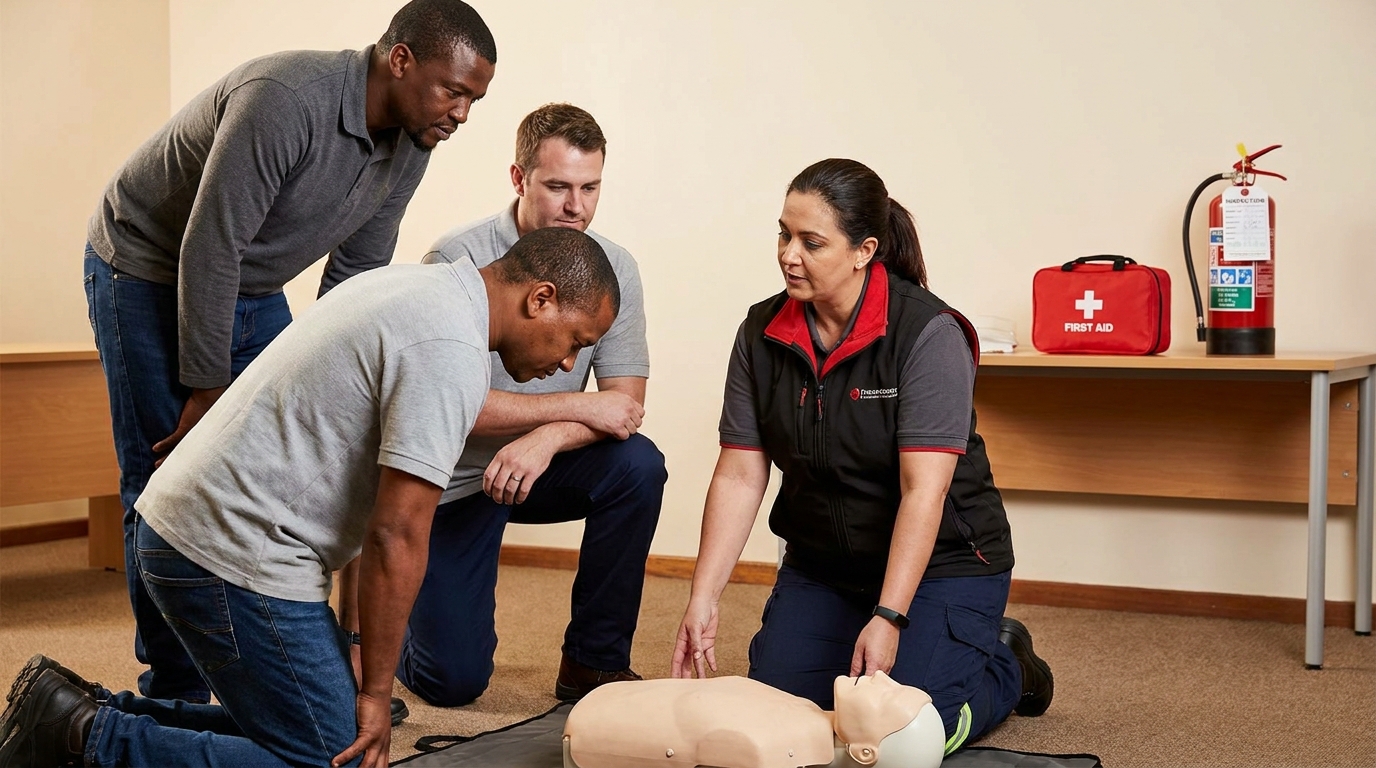
Training gaps are a common findings in South African workplace health and safety audits. Training gaps show up in several ways during an audit; expired first aid and OHS training certificates are among the most common.
The General Safety Regulations of the OHS Act specify that First Aiders must hold a valid first aid certificate from an approved training provider. First aid certificates usually carry a three-year validity period, at which point First Aiders must attend another first aid course to refresh their skills. Similarly, firefighting certificates, Health and Safety Representative certificates, and supervisor-level OHS certificates usually carry validity periods and renewal requirements.
Beyond certificates, employee interviews may reveal that employees are not familiar with emergency evacuation procedures, do not know the location of the nearest first aid box, or have not received training on risk controls relating to their work.
Should an audit identify non-compliance regarding health and safety training, the remedy is to schedule the required training with an accredited provider. Our first aid training courses and health and safety trainingprogrammes are accredited courses that fulfil the requirements of the OHS Act.
Common health and safety audit findings in South African workplaces
While every workplace is different, there are some common areas of non-compliance with South African health and safety legislation that organisations find:
-
No appointed or inadequately trained First Aiders relative to the number of employees
-
Fire extinguishers that have not been serviced or are incorrectly positioned
-
Risk assessments that have not been annually reviewed or repeated after changes to equipment, processes, or equipment
-
Health and Safety Representatives who have not received the formal training
-
Evacuation drills are not conducted at least twice a year
-
Incident investigation reports that record what happened but do not identify root cause or corrective action
FAFST can assist you with your health and safety audit
A workplace health and safety audit is not the end of the process; it is the starting point of the process of making your workplace more compliant, healthier, safer, and better-prepared for emergencies.
If your organisation lacks the resources to conduct a comprehensive internal health and safety audit, FAFST offers full OHS Compliance Assessments. Our OHS experts review your existing health and safety system, including documentation, risk assessments, organisational structures, training procedures, equipment and meetings. You receive a detailed report with a percentage compliance rating, identifying compliant and non-compliant areas against the OHS Act, its regulations and municipal by-laws. These findings provide a clear basis for planning improvements to your organisation’s health and safety compliance.
If your audit or assessment shows that you haven’t met your health and safety training requirements, FAFST offers accredited courses across first aid, firefighting, and occupational health and safety that meet South African legislative requirements. Contact our team to discuss your training requirements or view our first aid courses, firefighting courses, and health and safety training courses.