
If your workplace employs more than five people, South African law requires you to have a compliant first aid box on site. The General Safety Regulations of the Occupational Health and Safety Act specify what must be inside your first aid kit, commonly referred to as a Regulation 3 first aid kit.
This guide breaks down exactly what Regulation 3 requires, what should be in your kit, and how it differs from a Regulation 7 first aid kit.
What is ‘Regulation 3’?
‘Regulation 3’ refers to Section 3 of the General Safety Regulations of the Occupational Health and Safety Act 85 of 1993 (OHS Act). It sets out the legal requirement for employers to provide first aid, first aid equipment, and procedures in the workplace.
The regulation states that an employer must take all reasonable steps necessary to ensure that persons at work receive prompt first aid treatment in case of injury or emergency. Specifically, General Safety Regulation Section 3(2) requires that where more than five employees are employed at a workplace, the employer must provide a first aid box or boxes that are available and accessible for treating injured persons.
Section 3(3) goes further, requiring employers to take into account the type of injuries likely to occur, the nature of the work performed, and the number of employees when determining the first aid equipment needed, and confirms that the first aid box must contain, at a minimum, the items listed in the Annexure to the General Safety Regulations.
Who needs a Regulation 3 First Aid Kit?
Any South African workplace with more than five employees is legally required to have at least one Regulation 3-compliant first aid box easily accessible on site. Even where a workplace employs fewer than five people, providing basic first aid supplies remains good practice and reflects an employer’s broader moral duty of care toward employee health and safety.
The number of first aid kits required depends on the size of the workplace, the number of employees, and the layout of the premises. A practical guideline is to provide at least one first aid kit for every 50 employees. In workplaces spread across multiple floors, each level should have its own readily accessible first aid kit. Organisations operating in higher-risk environments may need additional kits, with one located in each department, work area, or designated high-risk zone to ensure prompt access during an emergency.
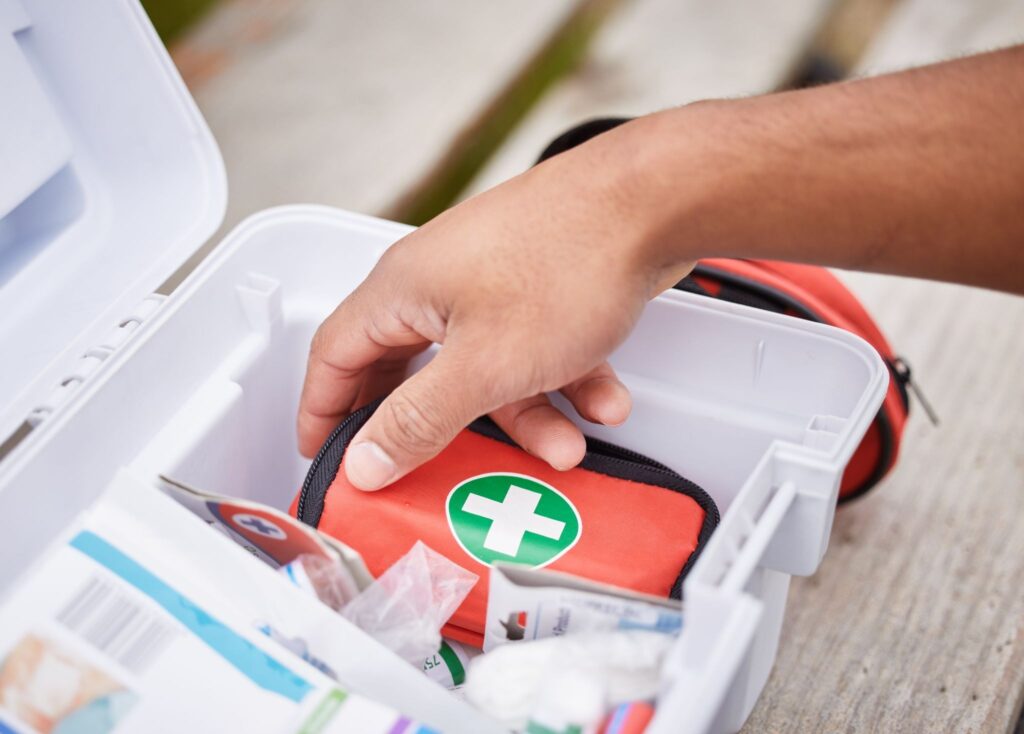
Regulation 3 First Aid Kit contents: The full checklist
The Annexure to the General Safety Regulations sets out the minimum required contents of a compliant first aid box. To meet OHS Act requirements, your kit should contain:
| Item | Minimum Quantity |
| Wound cleaner/antiseptic | 100ml |
| Swabs for cleaning wounds | – |
| Cotton wool for padding | 100g |
| Sterile gauze | Minimum 10 |
| Forceps (for splinters) | 1 pair |
| Scissors (minimum size 100mm) | 1 pair |
| Safety pins | 1 set |
| Triangular bandages | 4 |
| Roller bandages (75mm x 5m) | 4 |
| Roller bandages (100mm x 5m) | 4 |
| Elastic adhesive roll (25mm x 3m) | 1 |
| Non-allergenic adhesive strip (25mm x 3m) | 1 |
| Adhesive dressing strips (assorted sizes) | Minimum 10 |
| First aid dressings (75mm x 100mm) | 4 |
| First aid dressings (150mm x 200mm) | 4 |
| Straight splints | 2 |
| Large disposable latex gloves | 2 pairs |
| Medium disposable latex gloves | 2 pairs |
| CPR mouthpieces (or similar barrier devices) | 2 |
A well-stocked Regulation 3 first aid kit is designed to address the most common workplace injuries, like cuts, abrasions, minor burns, sprains, and the need to control bleeding before professional medical help arrives.
- Wound cleaner, swabs, and cotton wool allow a First Aider to clean wounds before dressing them, reducing infection risk.
- Sterile gauze and dressings of varying sizes cover injuries ranging from small cuts to larger wounds and can be used to control bleeding.
- Bandages secure dressings in place and can be used to create slings or immobilise an injured limb.
- Forceps and scissors allow for the safe removal of splinters or debris in wounds and cutting of clothing, dressings, or bandages.
- Splints provide support for suspected fractures or sprains until further treatment is available.
- Disposable gloves protect both the casualty and the First Aider from infection.
- CPR mouthpieces allow a First Aider to safely perform rescue breaths without direct mouth-to-mouth contact.
Where should the first aid kit be kept?
A first aid kit is only useful if it can be quickly and easily accessed in an emergency. Your first aid box must be:
- Positioned where it is easily accessible to all employees during working hours
- Free from obstructions
- Clearly marked with appropriate health and safety signage so it can be located quickly in an emergency; affix signage showing a green cross and a green arrow pointing to the first aid box
- Where mounted to a wall, ensure that the first aid kit can be easily removed and taken to the scene of an injury
Regulation 3 kit vs Regulation 7 kit: What’s the difference?
The General Safety Regulations specify the minimum contents required for a Regulation 3 first aid kit. However, the legislation does not explicitly define the contents of a ‘Regulation 7 first aid kit’ or prescribe a separate list of mandatory items.
In practice, the term ‘Regulation 7 first aid kit’ is widely used within the occupational health and safety industry to describe a first aid kit that includes additional equipment for the safe clean-up of blood and other bodily fluids.
Alongside the standard contents of a Regulation 3 first aid kit, these enhanced kits typically include extra items such as:
- High risk gloves
- Paper towels
- Plastic bags
- Plastic biohazard bag
- Plastic disposable apron
- Alcohol swabs and sanitizer
- Absorbent granules
Maintaining a compliant first aid kit
One of a First Aider’s duties is ensuring that the first aid kit remains well stocked and properly maintained. This requires:
- Regular inspections – checking stock levels and expiry dates on a scheduled basis (usually monthly)
- Prompt replenishment of any used or expired items
- Accurate record keeping – documented inspections demonstrate compliance during a DoEL inspection
Simply having a compliant first aid kit isn’t enough — legally, you need a certified First Aider on duty
The OHS Act stipulates that any workplace employing more than 10 employees must have a certified First Aider available during normal working hours. First Aid, Fire and Safety Training offers accredited First Aid NQF Level 1 training across South Africa. Our training is facilitated by experienced paramedics and includes a blend of theory and hands-on practice. Contact us to find out more and to book your spot.